|
|
Knowledge is a privilege. Passing it on is a duty. |
[Deutsche Version → Elementarkörpertheorie]
An Overdue Rendezvous with Causal Rationality
ß-Version
|
Current overall summaries
↓ |

|
Gravitation ↓ |
|
Matter Waves ↓ |
|
It began in Germany in 1900 with quantum physics... followed by quantum mechanics (QM). From an interdisciplinary perspective, with the explicit endorsement of the QM makers, QM proclaimers and QM beneficiaries, quantum mechanics is deliberately misleading and deliberately incomprehensible. The public loves metaphysics or esotericism. According to Theodor Fontane this is not surprising, because: „The sensational is what counts and only one thing still draws the crowd with ever greater enthusiasm – sheer nonsense."
For information and self‑analysis
Is quantum mechanics (really) incomprehensible?
Mathematical background, original meaning and purpose, deliberate renunciation of intuition
Hilbert spaces instead of intuition
Copenhagen interpretation of 1927 Albert Einstein’s criticism
Interestingly, it was Albert Einstein (1879–1955) who, from the very beginnings, identified quantum mechanics as unusable, with comprehensible argumentation:
Myth of “theory creates” [theory creates] To be able to understand at a higher level why the Standard Model of (elementary) particle physics (SM) and the Cosmological Standard Model (ΛC[old]D[ark]M[atter] model) could become established without much resistance, it should be noted that these model considerations had and have no significance whatsoever for real‑world physics research, i.e., materials and applied research. This applies both to “diagnostics” (material investigations) and to the construction of (material) applications. The fact is: Theoretical models always lag(lagged) behind (measurable) reality. The myth that highly complex, mathematical theories could and can describe reality and generate something new lives on. However, the fact that the predictive abilities of theoretical models, upon closer inspection, are results of repeatedly (new) post‑corrections escapes most interested parties. Real‑object interpretations are born within the standard models from mathematically formalized (sometimes esoteric) concepts. Theoretical constructs have been adjusted again and again over decades to ever more precise measurement results. Whether through additional calculations, new quantum numbers, new interaction postulates and new substructure theses, as well as extremely time‑intensive, iteratively‑algorithmically post‑corrected results using cluster computing systems or “supercomputers”. The ~125‑year reign of quantum physics and its 90‑year cosmological extension do not rest on a solid phenomenological foundation, but on a steadily growing mountain of ad‑hoc assumptions, free parameters and theory‑laden interpretations. |
|
|

|
Elementary Body Theory |
|
WARM UP! |
|
Let's begin with the derivation of the most famous equation, also across disciplines...
The purported derivation of E = mc2 according to Special Relativity |

Elementary Body Theory
based on the work on mass‑space coupling by Dirk Freyling
1986 2012 2026
|
The alternative thought-model described below (Elementary Body Theory, EBT for short) is based »catchword‑psychologically« on the assumption that significantly simpler, consistent descriptions of matter and resulting simple formalizations exist than those announced in the standard models. The following remark by Karl Popper (1902 – 1994) addresses the psychological problem of the »modern scientist« in the context of highly complex, mathematical model concepts: …" Our investigation shows that even obvious connections can be overlooked if we are repeatedly hammered that the search for such connections is ‘meaningless’." Karl Popper, The Logic of Scientific Discovery. 9th ed. Mohr, Tübingen 1989, p. 196. Ed. E. Botcher: Die Einheit der Gesellschaftswiss. Vol. 4; The Logic of scientific discovery. (1935); 2nd Ed. London , New York : Basic Books 1959
The Elementary Body Theory (EBT) represents a radical break with established theoretical physics. Instead of secondary concepts such as mass, energy, or charge, the primary, sensually experienceable quantity of radial extension (r) takes center stage as the sole parameter. Based on a fundamental equation, the mass‑radius constant equation [F1], m0 · r0 = 2h/(π · c), both microscopic quantities (such as proton radius, electron radius, Rydberg energy, neutron mass, magnetic moments, fine‑structure constant) and macroscopic quantities (e.g., age, mass and radius of the universe, temperature of the background radiation, vacuum energy density) can be calculated analytically without free parameters. The Elementary Body Theory refutes the theory‑postulated existence of neutrinos, quarks, and dark entities of the standard models, identifies these as theory‑laden artifacts, and traces all phenomena back to mass‑radius coupling. The justification and the resulting formalism is, literally, remarkably simple. Standard model physics gives space no energetic meaning. However, as soon as »space as a form of energy«* is understood, an energy‑conserving, consistent, easily formalizable, phenomenologically representable thought model emerges in which mass and space are energy carriers. Whereby, unlike the (concept of) space, the secondary concept of mass (the mass) is derived in the phenomenological origin of the EBT from the primary concept of space (body radius) mass‑radius coupled. The epistemological foundations are examined in the field of tension between Euclidean intuition and Hilbertian axiomatics. E = m · c² “everyone knows”. »Warm up«, as a concrete work performance of the EBT in the form of a pdf document (optionally in English or German), is therefore the first article published on dualismus.net in arXiv style, before the fundamentals and further thought‑model consequences of mass‑space coupling are presented online here. This will happen gradually. *
Established physics postulates an incomplete energy conservation because it does not know the space energy contained in the phenomenologically founded mass‑radius coupling. It must therefore postulate new, not directly detectable entities such as neutrinos for every apparent violation of the balance – as in beta decay – instead of recognizing the phenomenological reason for the energy transformation: dynamic space.
** Fundamental Remark on QM Interestingly, it was Albert Einstein (1879 – 1955) who identified quantum mechanics “early on” – with comprehensible argumentative reasoning – as unusable: …"the ψ‑function is to be understood as a description not of a single system, but of a community of systems. Roughly put, this result states: In the framework of statistical interpretation, there is no complete description of the individual system. Cautiously stated: The attempt to conceive the quantum theoretical description of individual systems leads to unnatural theoretical interpretations, which become immediately unnecessary if one accepts the view that the description refers to the ensemble of systems and not to the single system. Then the whole rigmarole to avoid the ‘physically real’ becomes superfluous. There is, however, a simple physiological reason why this obvious interpretation is avoided. For if statistical quantum theory claims not to completely describe the single system (and its temporal course), then it appears unavoidable to search elsewhere for a complete description of the single system, whereby it would be clear from the outset that the elements of such a description would not be contained within the conceptual scheme of statistical quantum theory. One would thereby admit that this scheme cannot in principle serve as the basis of theoretical physics. The statistical theory would – in the event of the success of such efforts – assume a position within future physics somewhat analogous to that of statistical mechanics within the framework of classical mechanics."… A. Einstein, Out of my later years. Phil Lib. New York 1950 page 498
Einstein's argument can be broken down into the following logical structure: Einstein's unbeatable arguments were and are still “simply” ignored to this day. Einstein's critical remarks, especially on quantum mechanics, ultimately led to his isolation. Although he later became a “media star”, he was scientifically without further significance. |
|
Why the Years 1986, 2012, 2026?
1986
2012
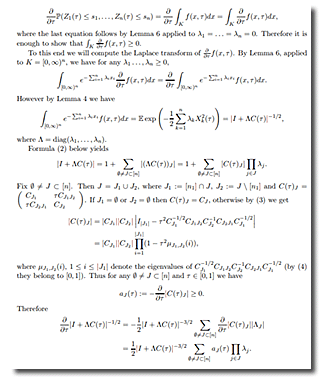
2026 Thomas Royen is a German statistics professor who, at age 67 and already four years in retirement, unexpectedly proved the so‑called Gaussian correlation inequality in 2014: The astonishing thing about Thomas Royen's proof is that he uses classical methods that basically any mathematics student can understand. The proof is only a few pages long...
Even after his eventual publication success, Royen was still annoyed for a long time about the fact that the established scientific journals ignored his work. Background: There were various mathematicians who tried in vain for decades to provide the proof. Since Royen moved rather on the sidelines of the mathematical community (out of the box), he was apparently able to approach the problem of proof more open‑mindedly than his specialist colleagues. His initial publication on this, however, was ignored in terms of content because it did not conform to the usual formatting. Only when other mathematicians became aware of his proof and “transformed” it into the standardized publication format was the work taken seriously. …much simpler than ‘everyone’ claims Of paramount importance here is the indication that Royen exemplarily exposes the currently greatest problem of knowledge development – especially in the field of basic theoretical research. The established thought concepts leave no room for purposefully simple thoughts. Standard theorists think and act as if their highly complex, complicated approaches were without alternative. Ultimately, they are not only colloquially stupid, but also arrogant and ignorant. This attitude, combined with destructively emotional character traits (more on this later), results in a fatal mixture for the ‘knowledge enterprise’. 2012 goes back to 2010, the somewhat longer explanation is displayed in a separate browser window, see »out of the box« |
Elementary Body Theory
An Overdue Rendezvous with Causal Rationality
|
|


|
What is it about? A sustainable paradigm shift.
What is meant by paradigm shift here? The replacement of the standard thought models [SM ΛCDM] of theoretical physics.
[SM] Standard Model of Particle Physics (SM)
What takes its place? A much more vivid, more effective, interdisciplinarily communicable, mathematically simpler thought model [EBT], which unifies and predicts the micro‑ and macro‑cosmos across scales. [EBT] The Elementary Body Theory (EBT) deals in particular with answers to the question of how mass and space are fundamentally linked and, in “interplay”, lead to understandable formations of matter that can be calculated formally‑analytically – both microscopically and correspondingly macroscopically. For an illustrative understanding and for the phenomenologically based equations of the Elementary Body Theory, demonstrably neither a variable time, nor mathematical space‑time constructs, nor any form of substructuring are necessary.
What arguments speak for this paradigm shift? The Principle of Parsimony [: Occam's razor lex parsimoniae law of parsimony]
The strictly analytically motivated use
Thought models can (only) be evaluated on consistency, internal axiomatic freedom from contradiction, with regard to the ability to make concrete predictions of actually measured quantities, and on minimalism. In order to describe experimentally verifiable relationships formal‑analytically within the framework of thought models, the thought model that makes the most precise predictions with the fewest (physical) variables and mathematically simplest equations is to be preferred. Furthermore, the most suitable thought model is the one that, besides the mathematics used, is phenomenologically graspable and consistent, can describe both the micro‑ and the macro‑cosmos (cross‑scale), and captures a formal and phenomenologically justifiable connection between light (more precisely photonsPh) and matter. [Ph] The term photons was first proposed in 1926 (21 years after Albert Einstein's work on the photoelectric effect) by the American physicochemist Gilbert Lewis in a paper titled “The Conservation of Photons”. He speculated whether light consisted of a new kind of atom, which he called photons, that could neither be created nor destroyed, thus obeying a conservation law [A. Pais “’Subtle is the Lord’… Albert Einstein – A Scientific Biography”, Vieweg 1986, p. 413]. A Comparison Thought Model Chemistry and Thought Model Physics First of all, according to my own authentic experiences and observations, university practical courses in chemistry cannot be compared with on‑the‑job training or everyday work in a company. I am a trained chemical laboratory technician, and as such I briefly worked rotating shifts in the production control of dyes. During my physics studies, I worked as a student assistant in physics education and occasionally as a temporary chemical laboratory technician for various companies in heavy industry, and I chose organometallic chemistry as a minor subject in my main physics studies. For both the physics and the chemistry sectors, it holds true that most teachers and many academically trained people, as well as doctors, are not researchers in their everyday professional lives. Applied physics is similar to chemistry. Practice makes one wise. The difference between chemistry and physics is that in chemistry, even the success of theoretical chemistry is mostly practical‑constructive, as applications follow (process engineering, products). In fundamental theoretical physics (especially the Standard Model of Cosmology [ΛCDM model] and the Standard Model of Particle Physics [SM]), there are no applications. Theory creation and theory extension remain pure speculation. I see chemistry didactics in upper secondary school or in basic studies as less problematic, because the “simple” models taught practically lead to good approximations. In physics, the situation is different. There, simplified concepts and theory elements are already “sold” to (upper) school students, which on closer inspection originate from philosophical and not physical thought models. Ultimately, theoretical physics defines itself through belief in a creative mathematics and postulated theory objects and interactions that cannot be directly detected, as well as a large number of free parameters. And as I said, this is only possible because no applications (have to) follow. For the transfer of knowledge, teachers and university lecturers are “forced” (to be) to convey the prevailing standard models, as it were. Personal views are, so to speak, “pedagogical‑administratively” not desired if they deviate significantly from the common method and/or from established thought models. |




 |
|
Although this is a scientific examination of the subject, there is also room for humor and interdisciplinary references. The mathematical and physical explanations are deliberately embellished with artistic visual elements, as it is fun to illustrate the vitality of the theory. The authenticity and egocentricity of the theory’s originator are not meant to remain a secret—and they will not.
|

WARM UP!
|
Looking back, the purported derivation of E = mc2 according to Special Relativity A critical analysis with comparison to the Elementary Body Theory Summary The equation E = mc2 is regarded as the most famous formula in physics. The standard answer to the question of its derivation is: From Albert Einstein's Special Theory of Relativity (SRT). This document presents the three common SRT‑derivations in detail: Einstein's original thought experiment of 1905, the modern derivation via four‑momentum, and the derivation via the energy‑momentum relationship. Each of these derivations is critically analyzed. It turns out that all SRT‑derivations are based on unproven postulates, contain arbitrary assumptions, or use approximations. In contrast, the derivation of the Elementary Body Theory (EBT) is presented, which derives E = m0c2 exactly, dynamically, geometrically vividly, and parameter‑free from the evolution equations r(t) = r0 sin(ct/r0) and m(t) = m0 sin(ct/r0). The appendix contains explanations on the history of thought models, the problems of quantum electrodynamics (QED), and some phenomenological foundations of the Elementary Body Theory. |
|
|
|
[BASIC SEARCH AlexDirkFreyling 59ndf Photo by T.B.] |

|
Author Dirk Freyling – independent researcher & artist [Artist name AlexD, hence also adf as author abbreviation] |