|
In advance, looking ahead “noted in the margin”...
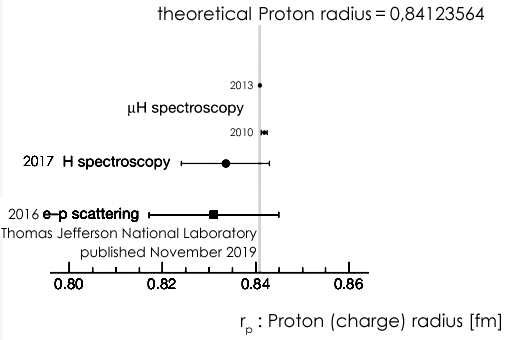
The physicists who had supposedly determined a ~ 4% larger
proton radius in electron‑proton scattering experiments fought for a long time
against the »Randolf Pohl & Co team«, who had repeatedly confirmed the smaller
proton radius in muonic hydrogen and later also in
regular hydrogen.
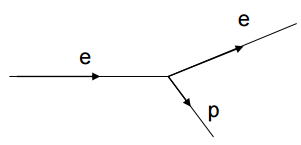
It turned out that the “fighters on a lost post” for a long time ignored
that the measurement error in their scattering experiments
was so large that the smaller proton radius measured value was already
contained within it.
|
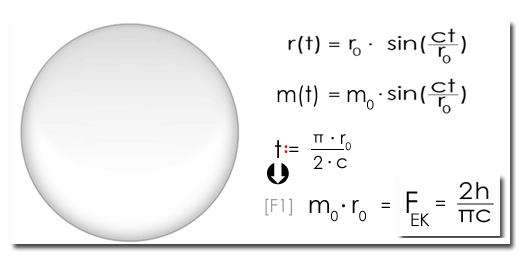
Elementary Body Theory (EBT) exactly calculated proton
radius in fm |
|
↓ |
 |
This little experimental interpretation story is a broad hint, as will be shown repeatedly later, that once
established experimental interpretations are only reluctantly revised by the
standard model protagonists.[EPM]
_______________________________________________________
[EPM] Explicitly noted: If one brings older measurements of
electron‑proton scattering concretely into “play”, proton radius values (»dispersion
fit«, 1996, … high energy part 0.832(12) fm, page 14…)
were already “discussed” in 1997 that agree well with the spectroscopically determined values for
muonic and regular hydrogen. Also or already Robert Hofstadter determined in 1958(!) a value of the proton radius
“compatible” with the Elementary Body Theory,
…Electron‑Proton‑Scattering Hofstadter et al 1958 rp = 0.80 +/‑ 0.04 fm
_______________________________________________________
Historical Notes on the Proton Radius Inherent in the Proton Mass
There was a (presumably little noticed) remark by Wolfgang
Finkelnburg from 1947 entitled “On the measure of
nuclear distances and a curious relationship between the
fundamental constants of physics” see: Finkelnburg
1947 reference
A Remark by Prof. Dürr on the Fundamental Nature of the
Proton
What suggests that the proton is actually fundamental is
a special coincidence to which the physicist Hans-Peter Dürr drew attention in
his essay »New Developments in High‑Energy Physics – the
End of Reductionism? (1986)«. He points
out that the idea of a particle substructure fails when
a characteristic threshold is reached.
This characteristic threshold results from the ratio
between Planck’s constant and the
speed of light. The resulting quantity has the
dimension of a mass times a length. According to Dürr, for
systems where the product of their mass m and their size R
falls below this measure, the notion of a
particle structure fails: mR << h/c » 10-37 g cm.
As Dürr emphasizes, this occurs for the first time with a
proton, because with the proton this limit is just reached: R » 10-13 cm,
m = 1.7 x 10⁻²⁴g, from which mR » 10-37 g
cm follows.
Dürr takes this striking coincidence as an occasion to criticize the
quark model. It seems to him, as he stresses, quite
strange that nature, in order to accommodate our particle picture,
resorts to such a special
dynamics as quantum chromodynamics on its deeper levels. It seems to him much
more convincing that the quark structure as well as a subquark structure
only has the function of an effective description in the sense of the
quasiparticle language of many‑body physics.
Source: Dürr, Hans-Peter, Neuere
Entwicklungen in der Hochenergiephysik – das Ende des
Reduktionismus? in: Selbstorganisation – Die Entstehung von Ordnung
in Natur und Gesellschaft, (edited by Andreas Dress, Hubert Hendrichs
and Günter Küppers, Munich 1986, pp. 15 – 34)
Hans-Peter Dürr (1929 - 2014) was, among other things,
a collaborator of Werner Heisenberg and director of the Max Planck
Institute for Physics until 1997.
Further
Michaele Suisse and Peter Cameron write in Quantum
Interpretation of the Proton Anomalous Magnetic Moment interestingly
the following …
“The role of the anomalous moment in the geometric
Clifford algebra of topological mass generation of the proton suggests
that the anomaly is not an intrinsic property of the
proton in free space, but rather a topological
effect of applying the electromagnetic bias field that
is necessary to define the eigenstates determined by the measurement of the magnetic moment.” [February 2017]
The, compared to the Elementary Body Theory, fundamentally different
approach of Michaele Suisse and Peter Cameron (thus also) comes
to the conclusion that the magnetic moment of the
proton is not intrinsic.
That is extremely
remarkable. For, as will be shown in detail, within the framework of the Elementary Body Theory the standard model approach of quark‑based
protons collapses. The
anomalous magnetic moment of the proton can be calculated most simply mass‑radius
coupled. |